
A Trusted Pilot Exam Preparation Provider for CPL & ATPL in India & Abroad
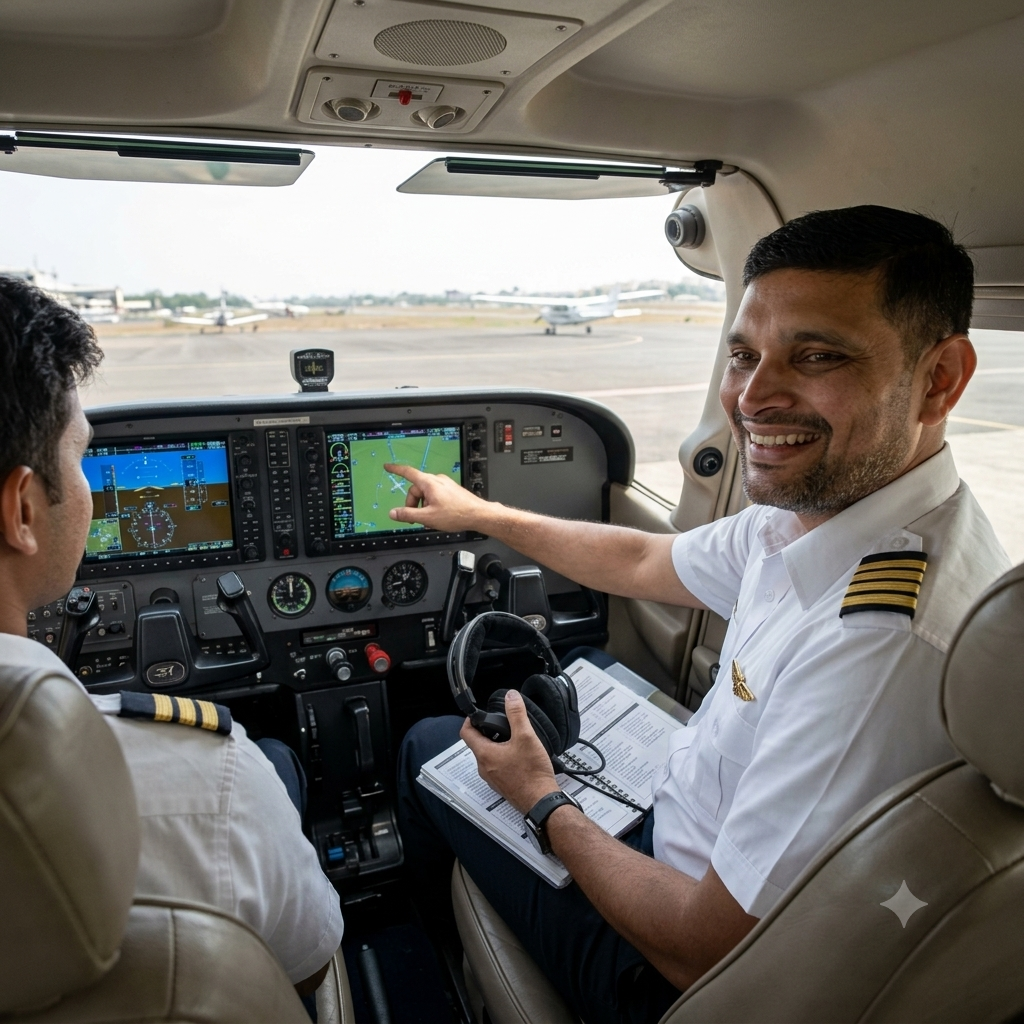
NAV-CPL
₹25,000
Air Navigation for Commercial Pilot License (CPL)
Air Navigation is widely considered the most mathematically demanding exam in the DGCA CPL lineup. This intensive 8-week module transforms raw numbers into precise, split-second cockpit decisions. Led by Captain Zaid, you will master step-by-step methods to solve the complex triangle of velocities, calculate exact drift corrections, and plot lines on charts under strict time pressure. We avoid shortcuts and focus entirely on building core mental tracking skills, giving you the workflows needed to solve the toughest numerical sections of the Central Examination Organisation (CEO) computer-based test framework.
Comprehensive Syllabus Scope
Our curriculum directly matches the official DGCA CPL examination blueprint, structured into five critical pillars:
Pillar 1: Baselines of Earth Geometry & Time
- Form of the Earth: Core geometry tracking Great Circles, Small Circles, Rhumb Lines, Convergency, and Conversion Angles.
- Coordinate Navigation: Using Latitude and Longitude systems to pinpoint physical positions, including precise differences in latitude ($\Delta\text{Lat}$) and longitude ($\Delta\text{Long}$).
- Aviation Time Mechanics: Converting between Universal Time Coordinated (UTC), Local Mean Time (LMT), Standard Time Zones, and crossing the International Date Line.
Pillar 2: Terrestrial Magnetism & Aircraft Compasses
- Earth’s Magnetic Properties: Resolution of total magnetic force into vertical and horizontal components, Magnetic Dip, and the layout of Isogonal lines.
- Compass Discrepancies: Converting between True, Magnetic, and Compass headings by tracking Variation and Deviation profiles.
- Aircraft Magnetism Errors: Calculating hard/soft iron magnetism distortions, acceleration errors, and Northerly/Southerly turning errors on standard direct-reading and remote-indicating compasses.
Pillar 3: Dead Reckoning (DR) & Flight Computer Dynamics
- Core DR Parameters: Practical application of Track, Heading, True Airspeed (TAS), Indicated Airspeed (IAS), Ground Speed (GS), Drift, and Wind Correction Angle (WCA).
- Flight Computer Masterclass: Daily hands-on practice solving multi-leg wind triangles, fuel consumption rates, time-speed-distance vectors, and unit conversions using the CRP-5 / CR-3 or ASA CX-3 computers.
- Critical En-route Targets: Calculating exact profiles for Point of Safe Return (PSR) and Critical Point (CP) / Equal Time Point (ETP) during cross-country flight planning.
Pillar 4: Aeronautical Charts & Visual Plotting
- Map Projections: Structural differences, scale variations, and tracking lines across Lambert’s Conformal Conic and Mercator charts.
- In-Flight Track Tracking: Measuring real-world drift errors, applying the 1-in-60 rule for off-track corrections, and managing flight log records mid-route.
Pillar 5: Radio Navigation Aids & Basic Flight Instruments
- Terrestrial Radio Systems: Working principles, frequencies, and errors of VOR, DME, ADF/NDB, and Instrument Landing Systems (ILS).
- Modern Space Systems: Basic GPS architecture, space segments, and signal errors.
- Air Data Instruments: Principles and errors of the Pitot-Static system, Altimeter, Airspeed Indicator (ASI), and Vertical Speed Indicator (VSI), alongside basic gyroscopic flight displays.
MET-01
₹25,000
Meteorology for Commercial Pilot License (CPL)
Aviation Meteorology is arguably the most dynamic and operationally vital subject in pilot training. This 8-week module goes deep into atmospheric physics, thermodynamic stability, and dangerous weather systems. Led by Captain Zaid, you will learn to transition from looking at dry charts to visualizing the live skies. We focus completely on building real-world weather awareness alongside passing your central exams. Rather than simply memorizing answers, you will learn to read code patterns and calculate shifts dynamically, thoroughly preparing you for the high-pressure Central Examination Organisation (CEO) computer-based test framework.
SYLLABUS SCOPE
Our curriculum directly covers the entire DGCA CPL examination framework, organized across five core pillars:
Pillar 1: Atmospheric Fundamentals & Altimetry
- Composition and vertical structure of the atmosphere: In-depth focus on the Troposphere, Tropopause boundaries, and Stratosphere dynamics.
- International Standard Atmosphere (ISA): Temperature, pressure, and density variations, along with calculating precise deviations from standard values.
- Aviation Altimetry: Master definitions of Height, Altitude, and Flight Levels. Advanced calculations for terrain clearance using accurate altimeter settings (QNH, QFE, QNE), including pressure and temperature errors.
Pillar 2: Thermodynamics & Wind Dynamics
- Adiabatic Processes: Differentiating Dry Adiabatic Lapse Rate (DALR) and Saturated Adiabatic Lapse Rate (SALR) against the Environmental Lapse Rate (ELR) to diagnose atmospheric stability and instability.
- Wind Mechanics: Forces driving wind direction (Pressure Gradient Force, Coriolis Force, and Surface Friction). Understanding Geostrophic vs. Gradient winds.
- Local Wind Phenomena: Operational management of Anabatic and Katabatic winds, Land/Sea breezes, and Venturi effects.
- Jet Streams & Clear Air Turbulence (CAT): Defining structural boundaries, seasonal shifts, core speeds, and strategic flight planning protocols for avoiding severe CAT.
Pillar 3: Clouds, Visibility Ailments, and Moisture
- Cloud Microphysics: Standard international cloud classification profiles (Low, Medium, High, and Significant Vertical Development formations like Cumulonimbus).
- Visibility Degradation: Physical differences, formation mechanics, and operational landing minima constraints for Radiation Fog, Advection Fog, Mist, Haze, and Smog.
- Precipitation Dynamics: Growth mechanics behind rain, snow, sleet, and freezing rain, mapping them directly to underlying cloud types.
Pillar 4: Frontal Systems & Subcontinental Climatology
- Air Masses and Fronts: Evolution, structural movement, and severe weather patterns associated with Cold Fronts, Warm Fronts, and Occlusions.
- Indian Climatology & Monsoonal Systems: Extensive study of the South-West and North-East Monsoons, Pre-Monsoon line squalls, Western Disturbances, and regional severe convective systems like Kalbaisakhi (Northwesters).
- Tropical Revolving Storms: Life cycle, tracking, and absolute avoidance vectors for Cyclones and severe depressions.
Pillar 5: Severe Flight Hazards & Weather Coding
- Critical In-flight Hazards: Severe Aircraft Icing (Rime vs. Clear Ice accretion mechanics), Low-level Wind Shear, and Microburst dynamics.
- Thunderstorm Physics: Detailed study of the three lifecycle stages (Cumulus, Mature, Dissipating), squall lines, downbursts, and airborne weather radar avoidance strategies.
- Aeronautical Code Mastery: Rapid decoding and practical application of live METAR, TAF, SPECI, SIGMET, and Significant Weather Charts (SIGWX) for pre-flight planning.
ARG-ALL
₹25,000
Air Regulations for Commercial Pilot (CPL) & Airline Transport Pilot License (ATPL)
Air Regulations is the ultimate legal boundary for operations in command of an aircraft. This 8-week module bridges the gap between fundamental aviation law and highly complex, multi-crew transport aircraft operations. Led by Captain Zaid, this combined track systematically addresses the standard CPL core criteria while aggressively preparing ATPL candidates for the advanced commercial compliance standards required by the Central Examination Organisation (CEO). We strip down the legalese of national acts and international frameworks, transforming them into sharp, operational decision-making parameters that will ensure you pass your computer-based tests on the first attempt.
Comprehensive Syllabus Scope
This course covers the legal frameworks of ICAO conventions, the Indian Aircraft Act and Rules, advanced air traffic management, commercial operational procedures, accident investigation protocols, and the statutory responsibilities of an airline captain under DGCA mandates.
Pillar 1: Legislative Foundations & National Law (CPL & ATPL Foundations)
- Structural analysis of the Aircraft Act of 1934 and Aircraft Rules of 1937, mapping the legal penalties, licensing rules, and aircraft airworthiness structures.
- Rigorous integration of the latest Civil Aviation Requirements (CARs) across Section 2 (Airworthiness), Section 7 (Flight Crew Standards & Licensing), and Section 8 (Aircraft Operations).
- Adherence to the Indian Aircraft Rules 1954 (Public Health) and 2003 (Carriage of Dangerous Goods).
Pillar 2: Global Frameworks & ICAO Annexes
- The Chicago Convention of 1944: Air sovereignty, overflight rights for scheduled vs. non-scheduled services, cabotage laws, and customs airport protocols.
- Mastery of the Five Freedoms of the Air and international conventions (Tokyo, The Hague, Montreal, and Warsaw) regarding unlawful interference and liability.
- Deep-dive into core Annexes: Annex 1 (Personnel Licensing), Annex 7 (Nationality & Marks), and Annex 8 (Airworthiness).
Pillar 3: Flight Standards & Flight Rules (Annex 2 & Doc 8168)
- ICAO Annex 2 (Rules of the Air): Collision avoidance vectors, right-of-way rules, surface markings, visual signals, and interception protocols.
- Operational limits for Visual Flight Rules (VFR) vs. Instrument Flight Rules (IFR) and standard cruising level structures across national boundaries.
- Procedures for Air Navigation Services (PANS-OPS) — ICAO Doc 8168, Volume 1: Altimeter setting procedures, holding entries, and standard instrument departure (SID) / standard terminal arrival (STAR) tracking.
Pillar 4: Air Traffic Management & Airport Environments
- ICAO Annex 11 & Doc 4444 (PANS-ATM): Separation minima (lateral, longitudinal, vertical), transition layers, radar service protocols, and flight plan processing.
- Annex 14 (Aerodromes): Detailed analysis of physical dimensions, runway lighting configurations (PAPI, VASI, Approach Lighting System), signs, and markings.
- Support Protocols: Annex 12 (Search & Rescue), Annex 13 (Accident Investigation), and Annex 17 (Security/Hijacking).
Pillar 5: Advanced Airline & Multi-Crew Operations (ATPL-Specific Core)
- ICAO Annex 6 (Operation of Aircraft): Corporate airline operational control, flight document carriage, and multi-engine fuel scheduling.
- Flight Duty Time Limitations (FDTL): Extensive mastery of crew rest periods, maximum split-duty limits, and cumulative flight time constraints under Indian CARs.
- Crew Resource Management (CRM) & Threat and Error Management (TEM): Practical error-trapping frameworks, situational awareness degradation models, and aviation psychology metrics designed to pass the complex situational questions unique to the ATPL paper.
NAV-ATPL
₹25,000
Air Navigation for Airline Transport Pilot License (ATPL)
The ATPL Air Navigation module requires a complete transition from light-aircraft dead reckoning to heavy jet transport navigation principles. This intensive 8-week course is explicitly designed to dismantle the mathematical and systems-level complexities of the senior pilot syllabus. Led by Captain Zaid, you will master advanced flight computer techniques, high-altitude tracking, and advanced radio-navigation principles. We eliminate the guesswork from the Central Examination Organisation (CEO) test matrix, giving you the practical formulaic workflows and tactical tracking skills needed to clear this high-stakes theory paper on your very first attempt.
Comprehensive Syllabus Scope
Our advanced curriculum maps exactly to the official DGCA ATPL central examination guidelines, divided into five core pillars:
Pillar 1: Advanced Altimetry & High-Altitude Flight Mechanics
- Deep-dive Altimetry: Advanced calculations involving pressure altitude, density altitude, and true altitude corrections under non-standard temperature profiles.
- Reduced Vertical Separation Minimum (RVSM) airspace procedures, equipment requirements, and contingency protocols.
- High-Altitude Flight Tracking: Mastering Mach number conversions, Total Air Temperature (TAT), Static Air Temperature (SAT), and advanced speed relationships (IAS vs. CAS vs. EAS vs. TAS).
Pillar 2: Global Geodesy & Aeronautical Charting
- Form of the Earth: Detailed study of the Earth’s ellipsoid model, convergence, departure calculations, and Great Circle vs. Rhumb Line navigation geometry.
- Advanced Charting Theory: Structural properties, scale scale variations, and projection mechanics of Lambert’s Conformal Conic and Mercator / Polar Stereographic charts.
- Plotting and tracking across high latitudes, grid navigation techniques, and calculation of polar track errors.
Pillar 3: Commercial Flight Planning & Jet Performance Operations
- Advanced Flight Computer Masterclass: Rapid execution of complex multi-leg wind triangles and drift calculations using the Jeppesen CR-3 or ASA CX-3 flight computers.
- Critical En-route Decision Points: Precise mathematical derivation of the Point of Safe Return (PSR) and Critical Point (CP) / Equal Time Point (ETP) under engine-out or depressurization scenarios.
- Jet Transport Performance: Analyzing fuel consumption planning, payload calculations, tankering strategies, and variable long-range cruise profiles.
Pillar 4: Inertial & Satellite Navigation Systems (EFIS Architecture)
- Inertial Navigation Systems (INS) & Inertial Reference Systems (IRS): Laser ring gyros, accelerometers, alignment phases, Schottky drift, and position updating logic.
- Global Navigation Satellite Systems (GNSS): Detailed architecture of GPS/GLONASS/Galileo, Receiver Autonomous Integrity Monitoring (RAIM), and Satellite/Ground-Based Augmentation Systems (SBAS/GBAS).
- Electronic Flight Instrument Systems (EFIS): Control and display units, symbols, and mode operations for Electronic Centralised Aircraft Monitor (ECAM) and Engine Indicating and Crew Alerting System (EICAS).
Pillar 5: Advanced Radio Navigation & Radar Systems
- Terrestrial Radio Aids: Core operating principles, errors, and signal limitations of VOR, Doppler VOR, DME, NDB, and Instrument Landing Systems (ILS / MLS).
- Modern Surveillance: Mode S transponders, Automatic Dependent Surveillance-Broadcast (ADS-B), and Traffic Collision Avoidance Systems (TCAS II architecture).
- Airborne Weather Radar (AWR): Beam characteristics, attenuation limits, tilt management, and specific techniques for identifying and bypassing severe convective cores and microbursts.
MET-ATPL
₹25,000
Meteorology for Airline Transport Pilot License (ATPL)
The ATPL Aviation Meteorology module is engineered for future captains who must make critical, high-altitude operational decisions under pressure. This 8-week module transitions away from fundamental thermodynamics to master global atmospheric dynamics, stratospheric tracking, and severe high-altitude weather systems. Led by Captain Zaid, you will learn to read complex upper-air charts, track dynamic global jet streams, and master the technical nuances of global weather forecasting systems. We strip away the ambiguity of the Central Examination Organisation (CEO) test bank, providing you with exact, data-driven analytical frameworks to clear this elite theory paper on your first attempt.
Comprehensive Syllabus Scope
Our advanced curriculum maps perfectly to the official DGCA ATPL central examination guidelines, divided into five core pillars:
Pillar 1: Stratospheric Physics & High-Altitude Altimetry
- The Upper Atmosphere: Detailed structure of the upper Troposphere and Stratosphere, including the dynamic behavior of the Tropopause (breaks, temperature variations, and height fluctuations relative to latitude).
- Advanced Altimetry at High Levels: Multi-level density altitude and true altitude corrections under extreme non-standard temperature layers. Flight level tracking under Standard Altimeter Settings (QNE) and handling pressure drops over mountainous terrain.
Pillar 2: Global Wind Systems & Jet Stream Mechanics
- Global Circulation Models: High-altitude wind behavior, including the Hadley, Ferrel, and Polar cells, and the seasonal migration of the Intertropical Convergence Zone (ITCZ).
- Jet Stream Masterclass: Deep-dive into Polar Front, Subtropical, and Tropical Easterly jet streams. Understanding core structures, wind shear zones, and tactical routing strategies to exploit tailwinds or mitigate clear air turbulence (CAT).
- Thermal Winds: Calculating and predicting upper-air wind vectors using the relationship between horizontal temperature gradients and pressure shifts with altitude.
Pillar 3: High-Altitude Flight Hazards & Convective Systems
- Severe Convective Complexes: Structure, tracking, and avoidance of Mesoscale Convective Systems (MCS), supercell thunderstorms, and equatorial squall lines at airline cruising levels.
- High-Altitude Icing: Ice crystal icing (ICI) mechanics, supercooled large droplets (SLD) hazards, and icing risks within high-altitude convective clouds.
- Volcanic Ash Dynamics: Tracking ash cloud dispersion, parsing VAAC (Volcanic Ash Advisory Center) bulletins, and standard engine/systems management protocols during volcanic ash encounters.
Pillar 4: Global Climatology & Regional Flight Routing
- World Weather Patterns: Climatological analysis of trans-oceanic routes, including the Pacific El Niño/La Niña oscillations, trade winds, and high-altitude monsoonal flows.
- Subcontinental Systems: Advanced analysis of the South-West and North-East Monsoons, jet-stream-driven Western Disturbances, and tracking severe tropical cyclones from formation to landfall.
Pillar 5: Advanced Meteorological Forecasting & Chart Parsing
- High-Level Weather Documentation: Professional reading and complete decoding of Significant Weather Charts (SIGWX), Upper-Air Wind/Temperature Forecast Charts, and constant pressure surfaces (e.g., 300 hPa, 250 hPa, 200 hPa charts).
- Advanced Coding Data: Rapid interpretation and operational application of live TAF, METAR, SIGMET, GAMET, and AIRMET logs across international flight information regions (FIRs).
- Satellite Meteorology: Interpreting infrared, visible, and water vapor satellite imagery to identify invisible hazards like CAT, mountain waves, and rapid cyclogenesis.
RAD-INST
₹25,000
Radio Aids & Instruments for Airline Transport Pilot License (ATPL)
The ATPL Radio Aids & Instruments module represents the true transition into modern glass-cockpit airline flying. This 8-week module shifts focus from basic cockpit gauges to complex, highly integrated avionics grids, automation architecture, and satellite-based approach procedures. Led by Captain Zaid, this track breaks down the physics of radio wave propagation, laser ring gyros, and advanced situational warning networks. We bypass rote memorization of acronyms to teach you how data flows between system sensors and the flight deck, fully preparing you for the advanced situational and technical questions favored by the Central Examination Organisation (CEO) computer-based test boards.
Comprehensive Syllabus Scope
Our advanced curriculum maps exactly to the official DGCA ATPL CARs Section 7 (Avionics) testing guidelines, divided into five critical pillars:
Pillar 1: Advanced Flight Deck Instrumentation (Air Data & Gyros)
- Electronic Flight Instrument Systems (EFIS): Internal operational architecture, symbol generation logic, and cross-talk validation between the Primary Flight Display (PFD) and Navigation Display (ND).
- Advanced Air Data Computers (ADC): Processing Pitot-Static variables to eliminate compressibility, density, and position lag errors. Unpacking digital processing of TAT, SAT, and Mach values.
- Gyroscopic Evolution: Mechanical gyros vs. Ring Laser Gyros (RLG) and Micro-Electro-Mechanical Systems (MEMS). Fiber optic sensor arrays and strapdown system physics.
Pillar 2: Terrestrial & Terminal Radio Navigation Systems
- Radio Propagation Theory: Wave bands (LF, MF, HF, VHF, UHF, SHF), ionospheric refraction, skywave vs. groundwave attenuation, and antenna design.
- En-Route Navigational Aids: Working principles, frequency allocations, operational range formulas, and distinct system errors for VOR, Doppler-VOR, NDB/ADF, and DME (including slant-range calculations).
- Precision Landing Facilities (ILS/MLS): Localizer and Glide Path transmitter antenna mechanics, beam bends, false courses, catch gates, and Category I/II/III minima parameters.
Pillar 3: Self-Contained, Satellite, and Area Navigation (RNAV/PBN)
- Inertial Reference Systems (IRS/INS): Accelerometer integration, stable platforms vs. strapdown units, alignment sequences, gyrocompassing, and calculating continuous drift errors (Schuler Tuning principles).
- Global Navigation Satellite Systems (GNSS): Core architecture of GPS/GLONASS/Galileo, code phase tracking, space/control segments, and Receiver Autonomous Integrity Monitoring (RAIM) fault isolation parameters.
- Performance-Based Navigation (PBN): Distinguishing RNAV vs. RNP specifications, critical containment bounds, and database execution via the Flight Management System (FMS).
Pillar 4: Aircraft Radar Architectures & Surveillance
- Primary & Secondary Radar: Pulse width dynamics, Minimum Detectable Signal, moving target indicators, and SSR Modes A, C, and S transponder data-link structures.
- Airborne Weather Radar (AWR): Pulse techniques, beam tilt mitigation, attenuation shadow identification, and utilizing the display to visually bypass convective cell cores and microburst lines.
- Automatic Dependent Surveillance (ADS): Mechanics of ADS-B (Broadcast) and ADS-C (Contract) tracking systems in multi-crew terminal and oceanic airspace.
Pillar 5: Automatic Flight Control & Cockpit Safety Warning Systems
- Autopilot & Flight Director Systems: Outer-loop vs. inner-loop control pathways, servomechanism feedback, automatic trim logic, and command/stabilization mode integration.
- Terrain & Traffic Awareness: Operational modes of the Enhanced Ground Proximity Warning System (EGPWS) and TCAS II tracking (interpreting Traffic Advisories [TA] vs. Resolution Advisories [RA]).
- Flight Deck Recording Infrastructure: Flight Data Recorders (FDR) and Cockpit Voice Recorders (CVR)—including mandatory underwater locator beacon frequencies and recording time mandates under DGCA laws.
TECH-GEN (CPL / ATPL)
₹25,000
Technical General for Commercial Pilot (CPL) & Airline Transport Pilot License (ATPL)
Technical General is widely considered the most expansive syllabus in the DGCA lineup. It demands that a pilot transition from a simple operator to a systems expert. This intensive 8-week module deconstructs aircraft structures, aerodynamics, powerplant mechanics, and high-voltage electrical grids into clear, logical concepts. Led by Captain Zaid, we skip pure rote memorization of aircraft components. Instead, we teach you how systems interact and fail, preparing you thoroughly for both the Central Examination Organisation (CEO) computer-based test and future airline type ratings.
Comprehensive Syllabus Scope
Our curriculum directly matches the dual testing parameters of the DGCA CPL and ATPL Technical General blueprints, divided into five core pillars:
Pillar 1: Principles of Flight & Advanced Aerodynamics
- Subsonic Aerodynamics: Laws of fluid dynamics (Bernoulli’s principle, Venturi effect), lift generation equations, boundary layer behavior, and stall mechanics.
- Drag Dynamics: Total drag breakdown, optimizing the lift-to-drag ($L/D$) ratio, and controlling wake turbulence.
- High-Speed Aerodynamics: Transonic and supersonic flight flows, Mach critical speeds ($M_{\text{crit}}$), shockwave development, aerodynamic heating, and high-altitude buffet boundaries.
- Flight Stability & Controls: Long-term and short-term stability (phugoid oscillations), primary vs. secondary flight controls, and high-lift devices (slats, slots, and complex flap systems).
Pillar 2: Aircraft Structures & Airframe Systems
- Structural Mechanics: Loads, stresses (tension, compression, torsion, shearing), and design concepts (monocoque, semi-monocoque airframes) utilizing modern composite materials.
- Hydraulic Infrastructure: High-pressure hydraulic architectures, system redundancy, accumulators, seals, and hydraulic fluid properties (Skydrol specifications).
- Landing Gear Units: Retraction systems, nose-wheel steering geometry, anti-skid brake logic, brake fade dynamics, and fusible plug thermal safety protocols.
- Pneumatic & Environmental Control: Bleed air distribution, air conditioning packs, cabin pressurization controllers, outflow valves, and explosive decompression mechanics.
Pillar 3: Powerplant Operations (Piston & Gas Turbine Engines)
- Piston Propulsion: Four-stroke internal combustion cycles, dual ignition safety, fuel-air mixture controllers, carburetor icing, turbocharging, and variable-pitch propeller dynamics.
- Gas Turbine Mechanics: Thermodynamic principles of the Brayton Cycle. Structural analysis of centrifugal vs. axial flow compressors, combustion chambers, and multi-stage turbines.
- Jet Engine Sub-Systems: Turbofan configurations (bypass ratios), FADEC (Full Authority Digital Engine Control) logic, thrust reverser deployment blocks, engine anti-ice routing, and surging/stalling recovery vectors.
Pillar 4: Aircraft Electrical Systems & Avionics
- DC Generation: Batteries (Lead-Acid vs. Nickel-Cadmium configurations), thermal runaway control, DC generators, starters, and busbar distribution networks.
- AC Generation: Alternators, Constant Speed Drives (CSD), Integrated Drive Generators (IDG), inverters, transformer-rectifier units (TRU), and split-bus vs. parallel electrical power management.
- Emergency Power: Ram Air Turbine (RAT) deployment, standby inverters, and essential bus isolation logic during a dual-generator failure.
Pillar 5: Fuel Networks, Ice/Rain Protection, & Safety Systems
- Fuel Feed Systems: Fuel tank geometry, fuel venting, low-pressure/high-pressure pumps, cross-feed fuel scheduling, and handling fuel icing with fuel-cooled oil coolers.
- Ice & Rain Abatement: Thermal pneumatic wing anti-ice loops, electrical windshield heating, de-icing boots, and rain-repellent systems.
- Fire Detection & Suppression: Fire loops (continuous wire vs. pressure-type detectors), engine and cargo bay fire extinguishing bottles (Halon/alternative agents), and smoke detection grids.
PPLG-COMP
₹25,000
PPLG Composite for Private Pilot License (General)
The PPLG Composite paper is often underestimated because it is for a private license, yet it carries a notoriously strict pass rate (~20% on the first attempt) because it tests ten different aviation sub-disciplines simultaneously. Led by Captain Zaid, this module consolidates the massive DGCA syllabus into unified, clear operational blocks. Rather than overwhelming you with multiple massive textbooks, we train you to shift gears cleanly between legal frameworks, navigation math, and meteorological charts. This course is optimized specifically to build the broad base of knowledge required to confidently pass this 3-hour central computer-based examination on your first try.
Comprehensive Syllabus Scope
Our curriculum breaks down the official DGCA Appendix A PPLG Composite framework into five integrated, high-yield pillars:
Pillar 1: Air Regulations & Legal Frameworks
- Indian Aircraft Law: Critical chapters of the Aircraft Act of 1934 and Aircraft Rules of 1937 pertaining to private aircraft ownership, pilot logbooks, and carriage of passengers.
- Rules of the Air (ICAO Annex 2): General flight rules, right-of-way geometry, collision avoidance visual signals, and basic cloud separation limits for Visual Flight Rules (VFR).
- Air Traffic Services (ATS): Aerodrome visual markings, runway lighting arrays, altimeter setting procedures (QNH vs. QFE), and VFR position reporting over Indian flight information regions.
Pillar 2: Private Pilot Air Navigation & Flight Computers
- Baselines of Earth & Maps: Lat/Long coordinates, Great Circles vs. Rhumb Lines, and practical visual map-reading on ICAO 1:500,000 aeronautical charts.
- The Triangle of Velocities: Calculating Heading, Groundspeed, Track, and Wind Correction Angle (WCA) using manual flight computers like the CRP-1 / CRP-5 or ASA CX-3.
- Terrestrial Magnetism: Mastering Variation, Deviation cards, turning errors, and acceleration errors on direct-reading magnetic compasses.
Pillar 3: General Aviation Meteorology
- Atmospheric Features: Vertical layers of the atmosphere, pressure variations, and density altitude impacts on light aircraft performance.
- Weather Conditions: Formation mechanics of Radiation and Advection Fog, Mist, Haze, and structural cloud classification (tracking low-level convective Cumulonimbus hazards).
- Subcontinental Weather & Coding: Decoding basic aeronautical weather data strings (METAR & TAF), understanding pre-monsoon lines, and localized wind shear hazards.
Pillar 4: Basic Instruments & Flight Performance Planning
- Pitot-Static System Instruments: Operational mechanics and direct blockage failures of the Altimeter, Airspeed Indicator (ASI), and Vertical Speed Indicator (VSI).
- Mass & Balance Control: Calculating center of gravity (CG) shifts, structural maximum weight limitations, and utilizing aircraft flight manuals to avoid stalls or performance degradation.
- Pre-Flight Logging: Preparing a standard VFR navigation flight log, estimating fuel endurance safety margins, and filling out official ATC flight plans.
Pillar 5: Human Performance, Operational Procedures, & Safety
- Aviation Physiology: Basic high-altitude limitations, hypoxia tracking, spatial disorientation, visual illusions during night landings, and carbon monoxide hazards in single-engine cabins.
- Emergency Operational Plans: Managing emergency checklists for engine/cabin fires, forced landings on unprepared terrain, ditching procedures, wake turbulence avoidance, and refueling fire precautions.
PPLG-TECH
₹25,000
Technical General for Private Pilot License (PPLG)
The PPLG Technical General module is where a private pilot learns to look under the cowling of their aircraft. This intensive 8-week module deconstructs the structural, mechanical, and aerodynamic realities of light general aviation aircraft (such as the Cessna 152/172 or Piper Archer). Led by Captain Zaid, this track bypasses complex jet mechanics to focus completely on what keeps light, single-engine piston aircraft flying safely. We teach you system interactions, pre-flight technical parsing, and unexpected system failure management, preparing you to clear the Central Examination Organisation (CEO) computer-based test on your very first attempt.
Comprehensive Syllabus Scope
Our curriculum directly matches the official DGCA PPL Technical General blueprint, divided into five core pillars:
Pillar 1: Light Aircraft Aerodynamics & Lift Principles
- The Physics of Lift: Practical application of Bernoulli’s Principle and Newton’s Third Law to light aircraft wing profiles, chord lines, relative airflow, and angle of attack ($AoA$).
- Forces in Flight: Managing the balance between Lift, Weight, Thrust, and Drag during straight-and-level flight, climbs, descents, and coordinated turns.
- Drag Breakdown: Differentiating Induced Drag (wingtip vortices) and Parasite Drag (form, skin friction, and interference drag), and understanding how airspeed affects total drag.
- Stall Dynamics: The critical angle of attack boundary, lift degradation, aerodynamic spin entry conditions, recovery techniques, and the dangerous effects of frost or structural ice.
Pillar 2: Aircraft Structures & Airframe Assemblies
- Structural Layouts: Structural engineering of Truss, Monocoque, and Semi-Monocoque airframe structures using aviation-grade aluminum and composite materials.
- Flight Control Surfaces: Mechanical linkage and operation of primary controls (Ailerons, Elevators, Rudder) and secondary controls (mechanical vs. electrical trailing-edge flaps, trim tabs, and aerodynamic balances).
- Landing Gear & Braking Units: Standard tricycle and tail-wheel structural geometry, shock absorption struts (Oleo-pneumatic systems), hydraulic disc brake operations, and nose-wheel steering/differential braking mechanics.
Pillar 3: General Aviation Pillar 3: Aircraft Powerplants (Internal Combustion Engine Operations)
- The Four-Stroke Cycle: Deep-dive into the thermodynamic Otto Cycle (Intake, Compression, Power, Exhaust) in horizontally opposed, air-cooled aero engines.
- Fuel Induction & Control: Carburetor physics, air-to-fuel mixture controllers (managing lean vs. rich mixtures at altitude), and the hazardous mechanics of Carburetor Icing (using carb heat safely).
- Ignition & Electrical Architecture: Dual magneto systems for safety redundancy, spark plug fouling detection, engine priming cycles, and battery-alternator DC electrical busbars.
- Propeller Dynamics: Aerodynamic forces on a fixed-pitch propeller vs. constant-speed propeller operations (understanding how the Governor regulates blade angle to match engine load).
Pillar 4: Crucial Airframe Sub-Systems & Fluids
- Engine Lubrication: Wet-sump vs. dry-sump oil paths, parsing oil pressure and oil temperature gauges, and identifying signs of critical engine friction damage.
- Fuel Infrastructure: Gravity-feed vs. fuel-pump delivery networks, fuel tank venting, selecting correct fuel grades (AVGAS 100LL vs. MOGAS), and fuel strainers/water contamination checking.
- Engine Cooling: Air-cooling optimization using cowl flaps, cooling baffles, and managing engine cylinder head temperatures (CHT) during prolonged climbs.
Pillar 5: Light Aircraft Instruments & Vacuum Infrastructure
- Pitot-Static System Instruments: Mechanical operation and direct blockage troubleshooting for the Altimeter, Airspeed Indicator (ASI), and Vertical Speed Indicator (VSI).
- Gyroscopic Display Instruments: Vacuum pump / engine-driven suction systems running the Attitude Indicator (Artificial Horizon), Heading Indicator (Directional Gyro), and the Turn Coordinator/Indicator.
- Engine Health Indicators: Tachometers (RPM gauges), Manifold Absolute Pressure (MAP) gauges, and Exhaust Gas Temperature (EGT) tracking for precise mixture leaning.

Your Client 1

Your Client 2

Your Client 3

Your Client 4